This week, we feature a guest post from our friend and fellow Riviera-resident Vaud Massarsky who used to work as a serial entrepreneur in the USA (where he, among other businesses, published a weekly New York City real estate journal and produced live drama as well as musicals) and now spends much of his time discovering the many sides of his adopted home region in the company of his lovely wife Felicia.
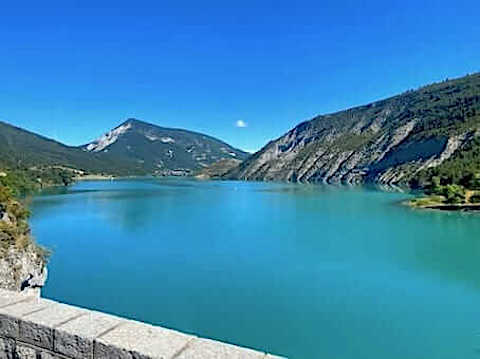
We live in Menton, but we hail from Manhattan, New York City. We are city people. As such, we yearn from time to time for more empty places, so our eye was caught by Digne, past the Var and into the Haute Provence: think 3,000 feet above sea level, massive peaks with vast expanses of forests.
The roots of Digne’s 18,000-strong community go back to Neolithic times. Later, the town became an important way station of the Roman Empire with its own thermal baths that are still functioning. As we don’t own a car, it was fortunate for us that Digne is the terminus of a quaint train line, the Chemins de Fer de Provence (CP), which is served by regular departures from Nice.
The hook was finally set when we queried a local shopkeeper about Digne-les-Bains and she said, “I go there for the change of vibe”. To experience this “change of vibe” from the Riviera coast requires a 4.5 hour commitment (3.5 hrs. from Nice), so we determined to stay overnight. In the end we liked it so much there that we added a second full day!
Indeed, one could go by car, a ride of about 3 hours, but that would spoil the fun. Over one-hundred-and-thirty years ago, thousands of workers toiled to cut 50 some tunnels and nearly the same number of bridges to connect Nice to Digne-les-Bains. Soaring metamorphic peaks, steep mountain sides, dizzyingly deep river valleys, all cut and fed by three rivers, the Bléone, the Mardaric, and the Eaux-Chaudes, which fall from great heights to (eventually) join the Mediterranean. So steep a climb and sharply undulating is the trip to Digne that the route could not be engineered by standard rail, which is why a narrow gauge track had to be used, about a third the width of normal track, and why all the rail equipment from locomotives to passenger cars is diminutive.
Herein lies the reason why one should not take a car: the views are spectacular, and if one is driving, it is too risky and nerve-racking to be looking around at the scenery. As a kicker, the smallness of the train sentiently anchors one into the thrill of the ride. One feels each track joint, like an old-fashioned trolley car.

Once in Nice, one must find the “CP” station. This station used to be a very big deal, called the Gare du Sud, a 19th century neo-classical showpiece, which rivaled any great rail station in stature. And it still stands! Renewed!
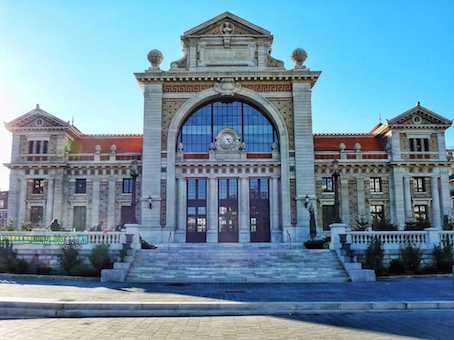
But this is not the currently-in-use CP station: that one is a 3-minute walk away. To find the Gare du Sud and the CP station just behind it, walk along Avenue Jean Médecin from Nice-Ville station, following the northbound tracks of tram line no. 1 for about 3 minutes until you reach the unmistakably grand Gare du Sud.
From there, take the line 49 train: it will whine, rock-and-roll, clickety-clack you up along the Bléone River past 49 villages, many of which will tempt you with their charms. You will want to get off the train to explore their medieval houses and streets as well as their lakes and river spots.
If you arrange your schedule to accommodate a diversion, in Annot, one could board a functioning steam train that plies these same rails to Digne.
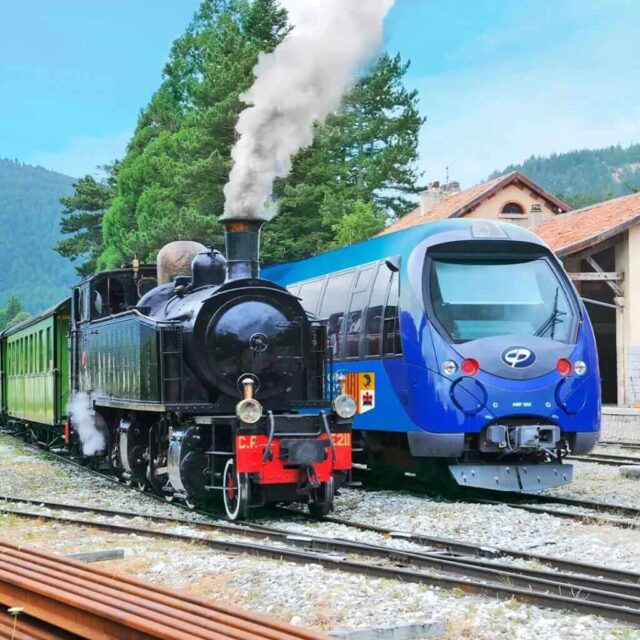
Go to the Le Train des Pignes website for scheduling information. Be aware that due to extensive maintenance works, the last part (45 mins.) of the journey to Digne may be by bus. But do not despair, the buses are modern and have panoramic windows.
From the CP Gare in Digne, it is about a 15-minute easy walk to town. We stayed at the Hotel Provence, 2 stars, clean, quiet, set back from the traffic, modestly priced, and going as an inn for 200+ years, before which it was a convent. It is a place steeped in history.
From there, you are only two short blocks away from Gassendi Boulevard that leads to the large central town square. It is lined by magnificent plane trees whose trunks are often three feet thick and very leafy. There are some side streets to wander about that come off Gassendi with a plethora of shops, boulangeries, patisseries, brasseries, and restaurants. Saturday and Wednesday are market days …
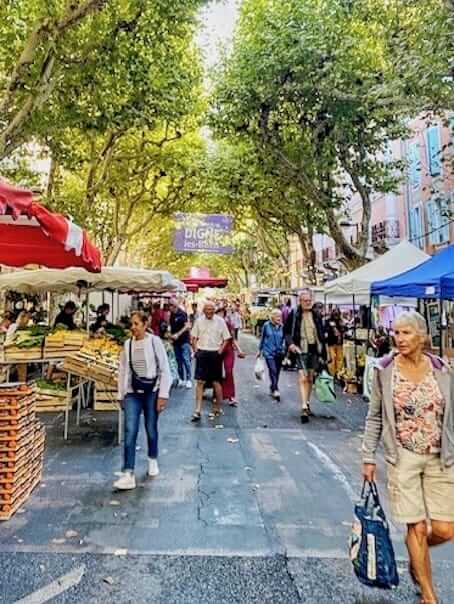
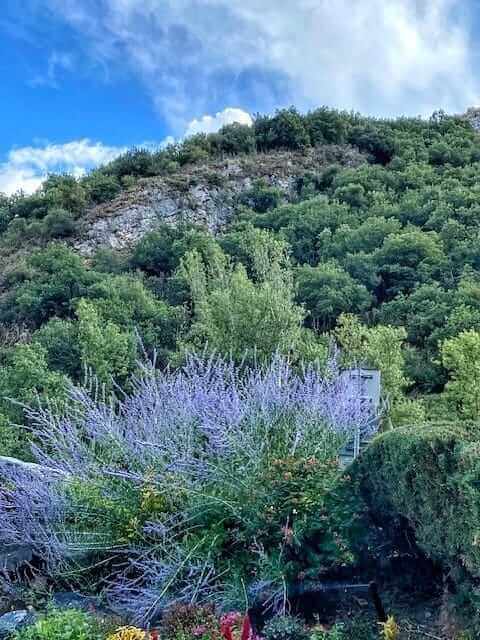
… and the town becomes an Eldorado of produce, prepared foods, cheeses, breads, condiments, meat, coffee, and lavender products (lavender grows in profusion here).
Take an adjacent street from Gassendi to the Cathedral Notre Dame du Bourg. Its backdrop is a massive rock outcropping that glares into the cathedral from the front door.
The architecture of Digne-les-Bains will make you remember why French villages are so universally popular: delightfully archaic, at times dilapidated, and welcoming in shades of ochre.
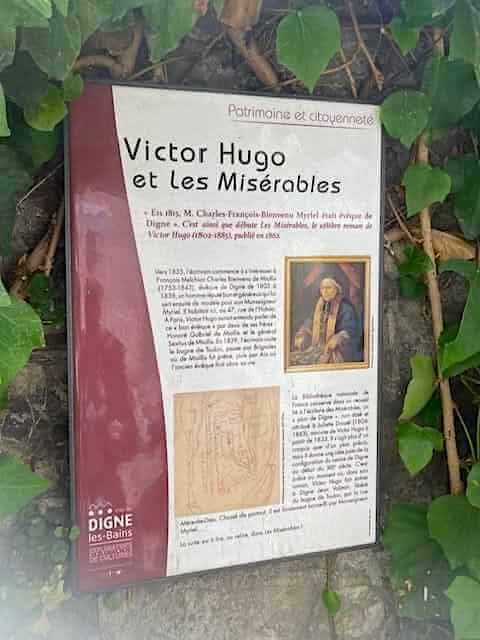
The town’s most famous inhabitant was Bienvenu de Miollis, bishop of Digne in the early 19th century, who – it is said – inspired the character of Bishop Myriel in Victor Hugo’s novel “Les Miserables” (the guy who owned the candlesticks). Digne, at any rate, is very proud of its connection to world literature – and rightfully celebrates it.
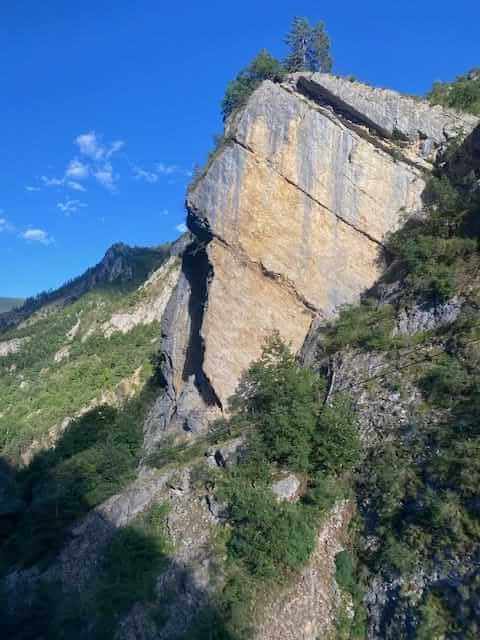
Standing guard around this city are the immense mountain slopes, thickly carpeted with trees, except where the metamorphic rock cores shoot through them straight up in jaw-dropping majesty.
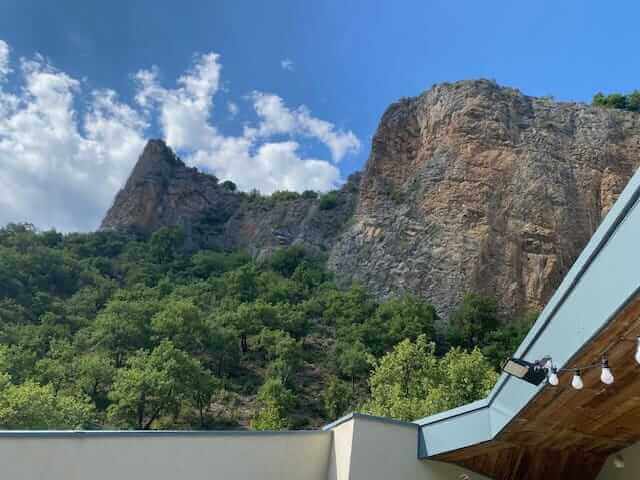
Digne itself was built on the valley floor created by the Bléone River. The flood plain is very wide, maybe 1/4 mile in some places. In the dry season, there is only a very modest flow, but in times of high precipitation, the entire flood plain is covered. Digne doesn’t receive much snow, about a foot a year, but 300+ days of sunshine. It is therefore not a ski resort per se – although you can find great skiing areas near-by – and more a place for calm and salubrious walks.
In addition to just strolling about, especially along a 2-mile stretch of the river, …
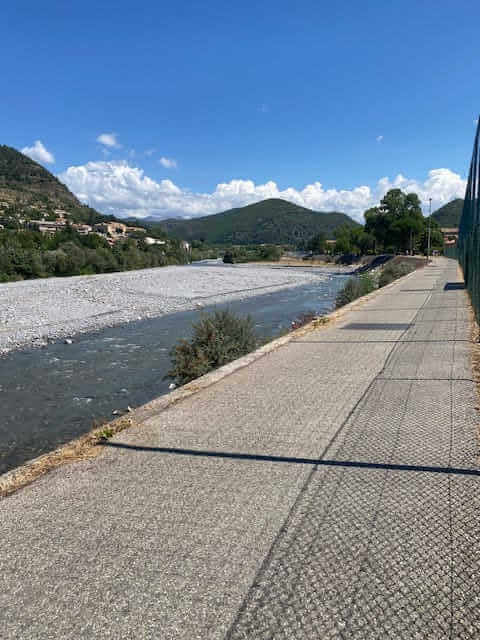
… you may want to visit three specific sites that speak volumes about Digne and its calm feel.
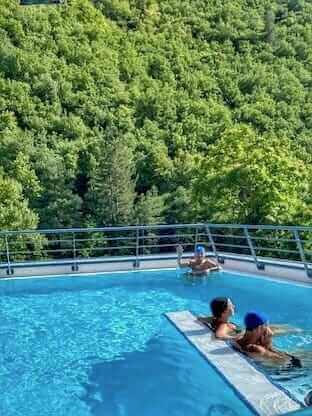
First, there are public thermal baths. Take a ten-minute ride from the town centre on the no. 2 bus. Digne’s buses are very modern, clean, and well-run. The baths are open daily from 2 PM to 7 PM and charge an entrance fee of 21 Euros per person. There are different pools with different water temperatures (from 68 F to 90 F). You can luxuriate in the sunlight, surrounded by the quiet mountain landscape, while soaking in the warm waters and then lounge on a deck. (No food or refreshments are served there.)
The ADN Museum on 27, Ave. du Maréchal Juin is dedicated to the exploits of the French anarcho-feminist Alexandria-David Néel (1868-1969) who was an opera singer, writer and philosopher and, in her later years, became transfixed by Buddhism.
Photo by Redacteur Tibet via Wikimedia Commons
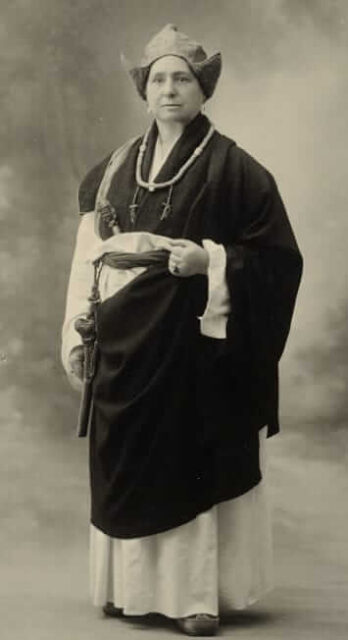
The museum follows – with brilliantly readable and interesting legends, pictures and artifacts – this unusual 100-year-long life of an indomitable woman who determined that she would do things denied to other women of her time such as being part of expeditions to Asia and Japan. She often dressed as a man to gain entry to male-dominated places. Her exploration of Buddhism, and the effect on her, has its lodestone in this paraphrase: “Buddhism is far more terrifying than Protestantism and other Judeo-Christian faiths;” perhaps referring to the need to give up material comforts.
And finally, the GeoParc …
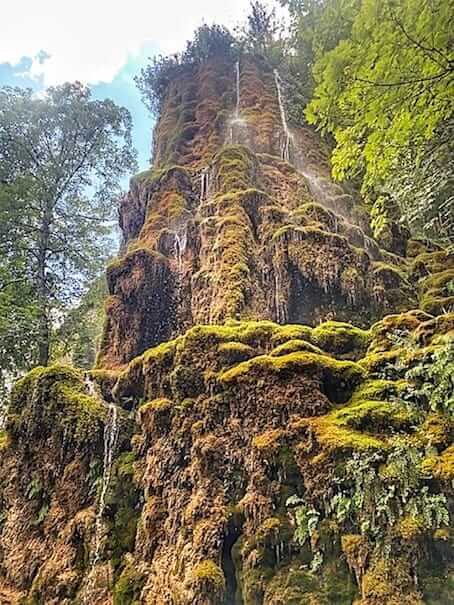
… which is separated from Centre Ville by a brief 10-minute ride on the line no. 2 bus.
This huge nature reserve will provide you with insights into the 300-million-year long history of the Alpes-de-Haute-Provence region. It is a hikers’ paradise with a fossil exploration trail, sculptures, explanations and specimens of the unusual rock formations in an educational center – plus, for the intrepid-and-curious, a dramatic waterfall. The Parc requires several hours to appreciate, and you can easily spend days on end exploring the area if you enjoy long hikes.
At the end of two days in Digne-les-Bains, one will have been able to leisurely explore the highlights of the town and its immediate surroundings.
Also, one will have become absorbed into the calmer quality of this easily negotiable flat place, the river plain, embraced by high mountains, and a rather constant breeze that rustles the leaves of the many trees, and in so doing, creates a cosseting quality that soothes the soul. It isn’t that there is no hustle and bustle, but it is greatly muted, subdued, by the glorious setting. That is priceless, different, and – we think – well worth the effort.