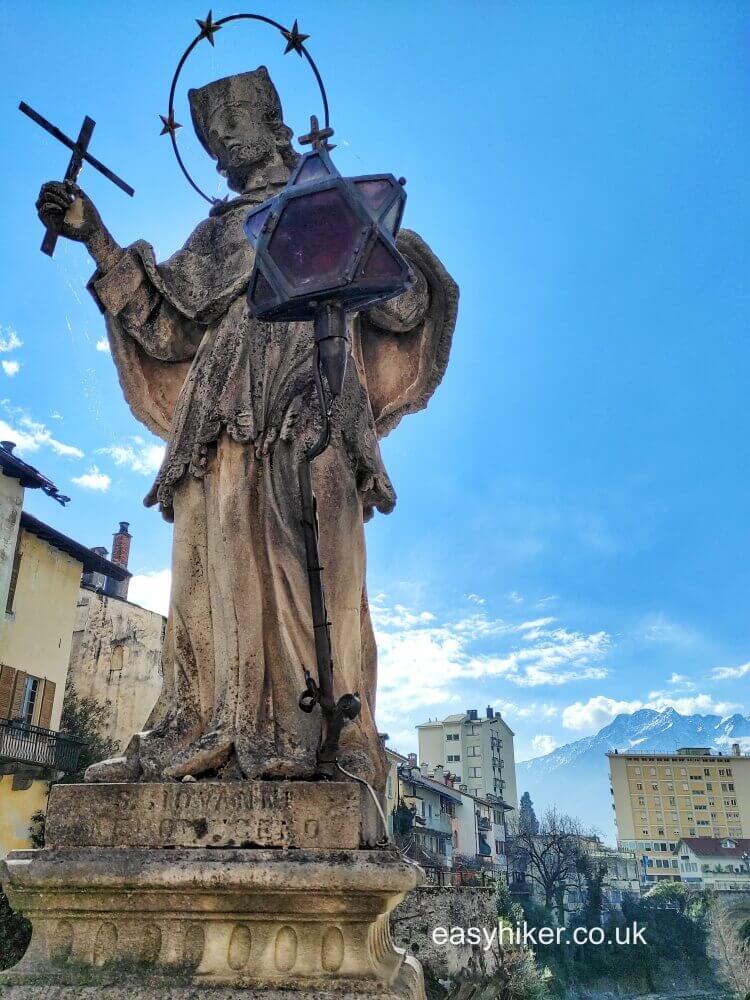
Italian cities share a family likeness that is – like all family likenesses – easier to recognise than to define. Is it the colours (above all, the blend of rich yellows), the delicately balanced proportions, the trompe l’oeil effects, the distinctly classical architectural features? It is probably a little bit from all of that.
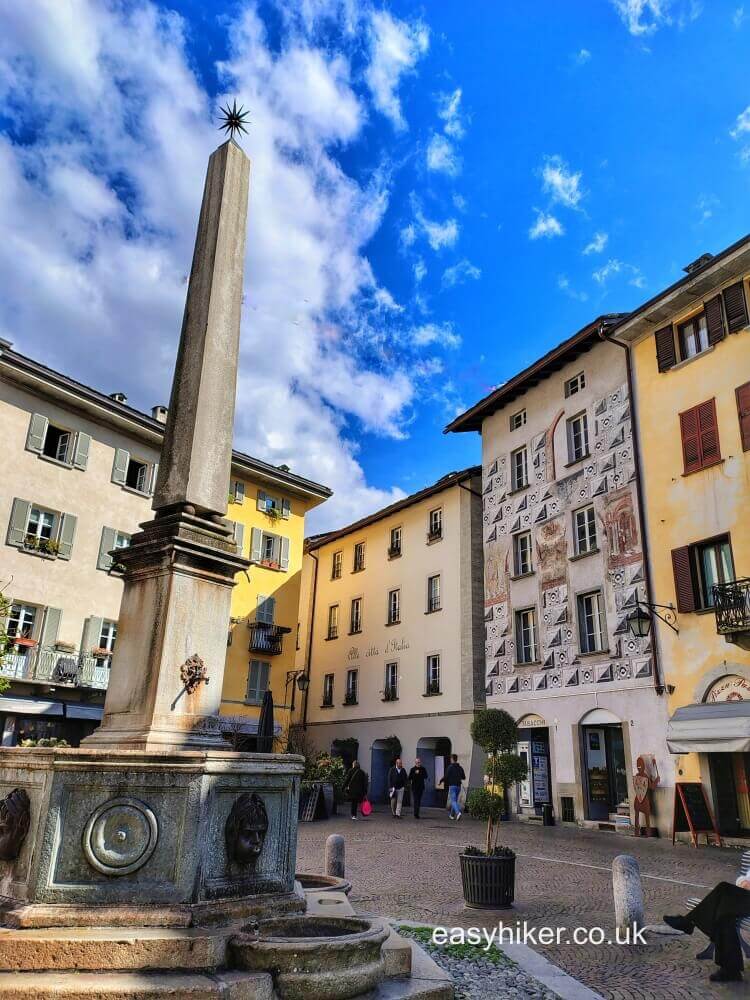
No such likeness exists within the family of the country’s landscapes. Italy is one of the most geographically diverse countries in Europe, although it does not often get credit for that.
Everybody knows about the scenic coasts, but Italy also has the wide open plains of the Po, the rolling hills of Umbria and Tuscany, the torched mountains of the South.
It even has a large section of the Alps, of course, and not only in South Tyrol which – let’s be frank for a moment – is not really Italy at all as anybody can attest who has ever entered a shop or a restaurant there to be greeted with a friendly Grüss Gott.
But while South Tyrol – or the Alto Adige, as it is known in Italy – does not look or feel specifically Italian, the Alpine landscapes in the west of the country are a different matter. When the mountains of Piemonte and Lombardia provide a scenic backdrop to Italianate townscapes, the result is often spectacular in a uniquely Italian way.
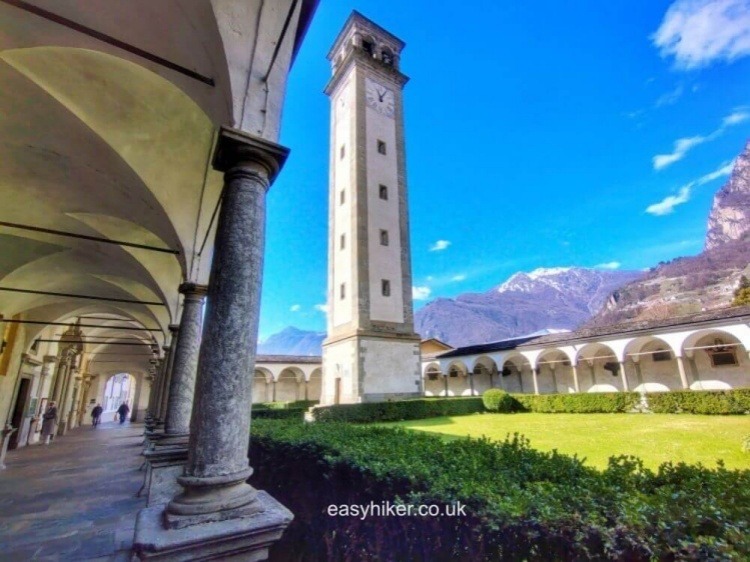
One of the towns where this magic works perfectly is Chiavenna.
The Magic of Chiavenna
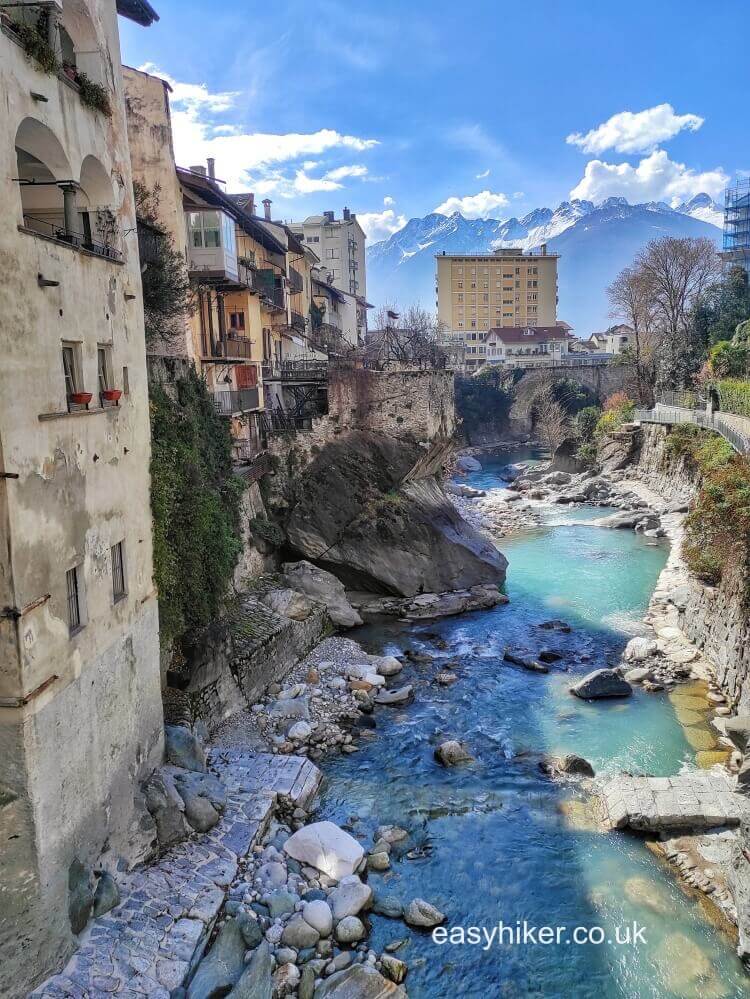
Chiavenna, strangely, was most fashionable when it was the most hard to get to. Goethe, George Eliot, Nietzsche, Leonardo da Vinci: they all travelled there the hard way (before the railway line was completed in 1886, this would have largely meant: on foot, and this would not have been an “easy hike”). Judging from the gushing words they wrote about their experience, however, they all appeared to believe that Chiavenna was well worth the effort.
Nowadays, trains take you there from Milan in under three hours and from Colico – where you have to board a special train for the last leg of the journey – in under 30 minutes, which makes Chiavenna the perfect destination for a day trip from Lake Como.
Most of the visitors you meet in the streets, however, appear to come from the other direction, especially from Switzerland in the North. (Chiavenna is the nearest local town to the Swiss border a little more than ten km away.) Italy’s main tourist flow, meanwhile, appears to pass Chiavenna entirely by.
So what can you see in Chiavenna if you travel there for the day?
Your sightseeing trip should concentrate on three sights – in principle, you can tick them off in any order, but we strongly suggest to visit the Parco delle Marmitte dei Giganti first.
Mainly because this nature reserve is very close to the train station: turn right into Corso Vittorio Emmanuelle, left at the Hotel Lorenzo and right again at the next intersection in the direction of the San Lorenzo collegiate church, which has existed, in some form or another, since late antiquity and whose oldest parts date back to the 12th century. The entrance of the Parco is located in the back of the adjacent cemetery – just follow the arrows.
Inside the park, you will have the choice between a range of signposted walks, some of them long, others a great deal shorter, but they all begin with the same steep ascent.
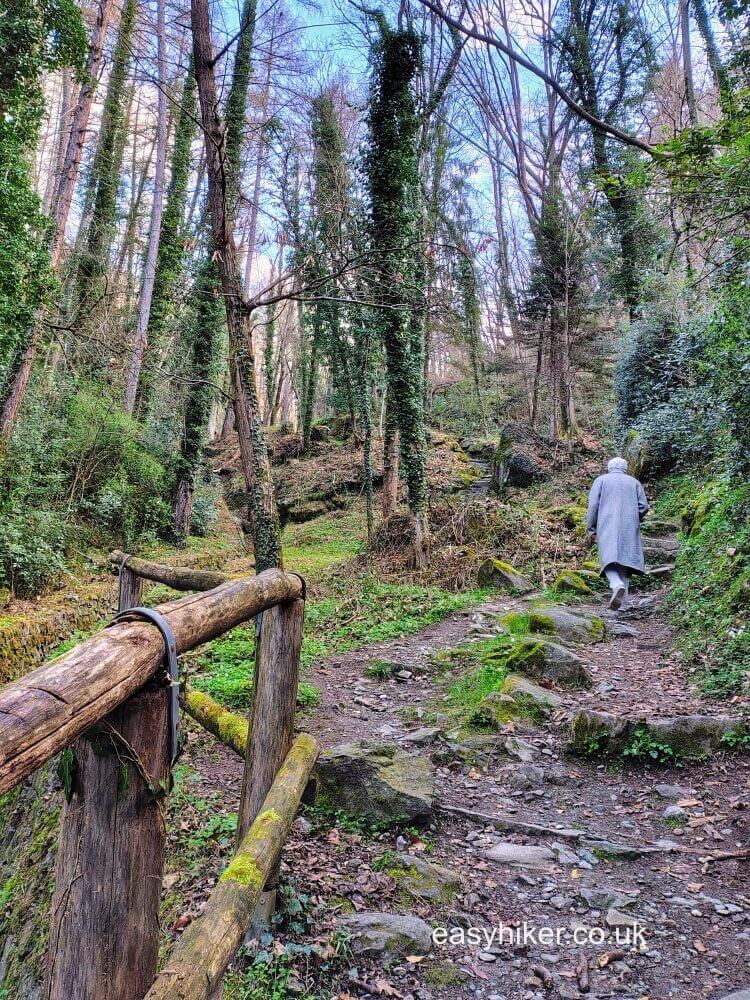
This is a great hike for light trainers such as tennis shoes. The ground is soft but not slippery, and there are just enough stones to provide firm ground for your feet on tricky patches. (This will be even more important for the descent on the way back.)
If you’re visiting as a family, the route is manageable for older children too, although a pair of kids’ hiking boots will make navigating the steeper sections and uneven paths a lot easier.
There are two strategies for exploring the wild landscape of the Parco: you can either look at a detailed description of what is on offer and take your pick in advance – or you just follow the trail that appears to take your fancy: the adventurers’ option.
We had originally intended to walk up to the Marmitte themselves, the “Pots of the Giants”, but in the event could not resist the lure of the caves high up on the magnificent boulders …
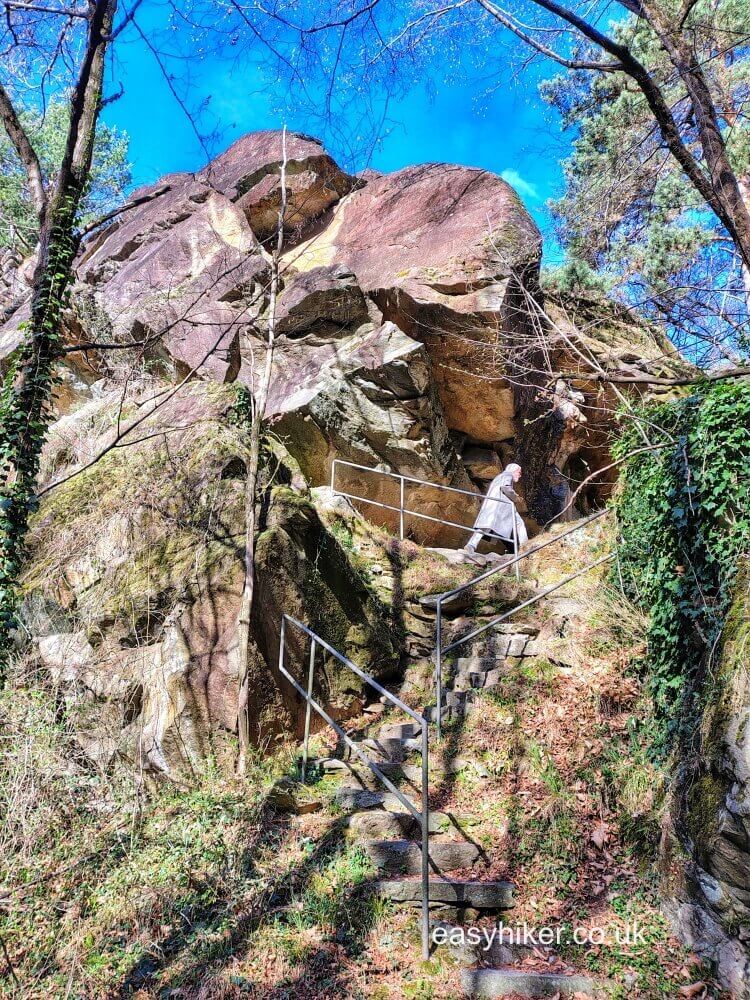
… so we followed this trail up the iron stairs and through some claustrophobically narrow footpaths …
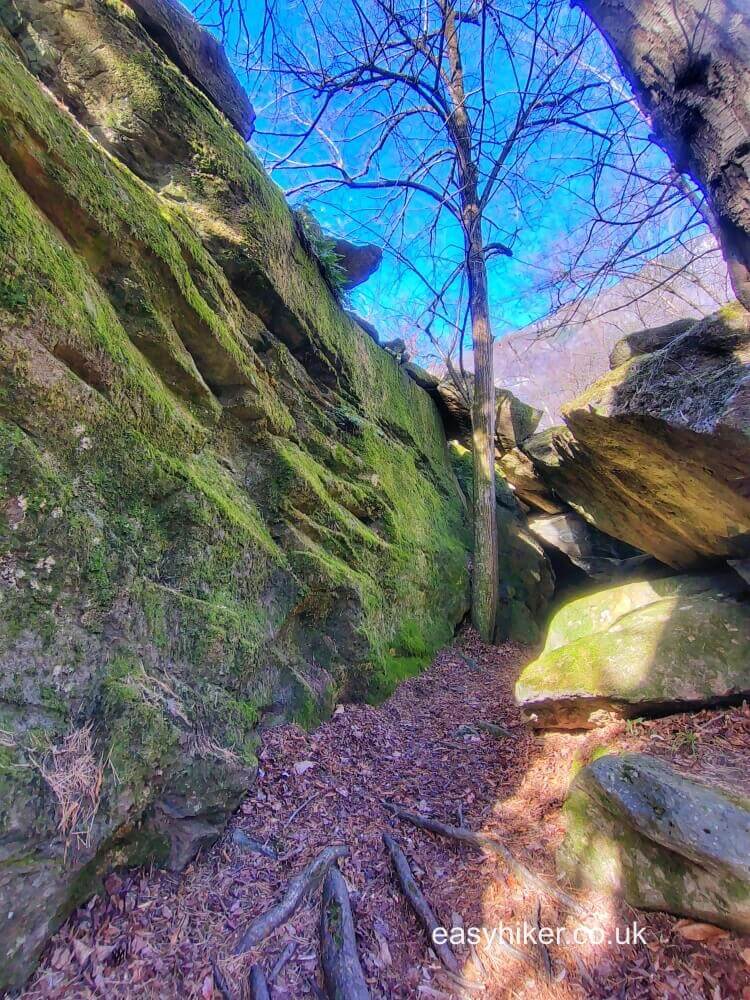
… until we reached the Belvedere, a viewing platform with a stunning Alpine backdrop. Made it, Ma: top of Chiavenna!
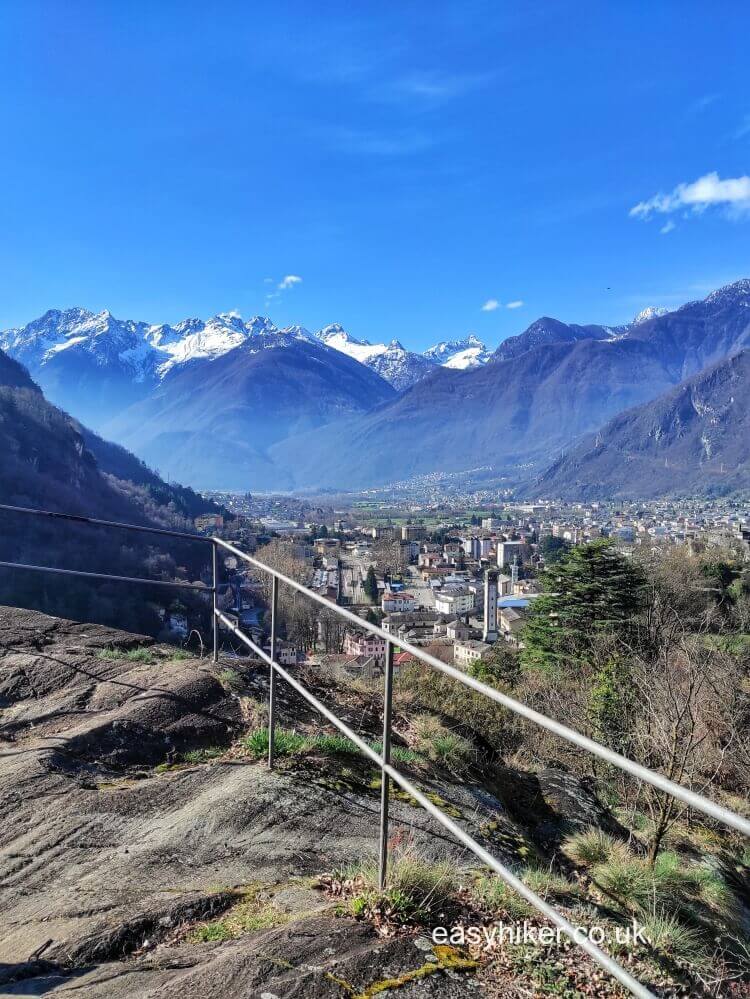
Once you have seen the town from above, you will be all the more keen on getting a closer look. You will find a lot of drama down there, too. The wild mountain river Mera crosses the town and, for a short stretch, a wooden walkway gives you a balcony view of how the spectacle of torrent-splashing-against-rocks unfolds.
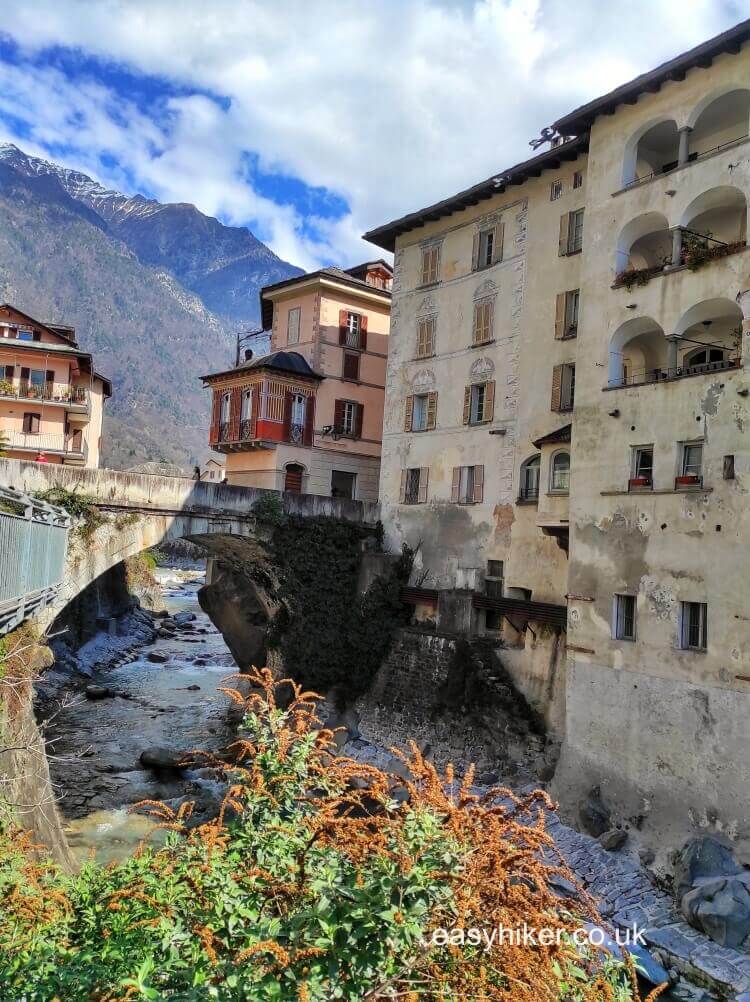
But Chiavenna’s town centre has a sweet and playful side, too, …
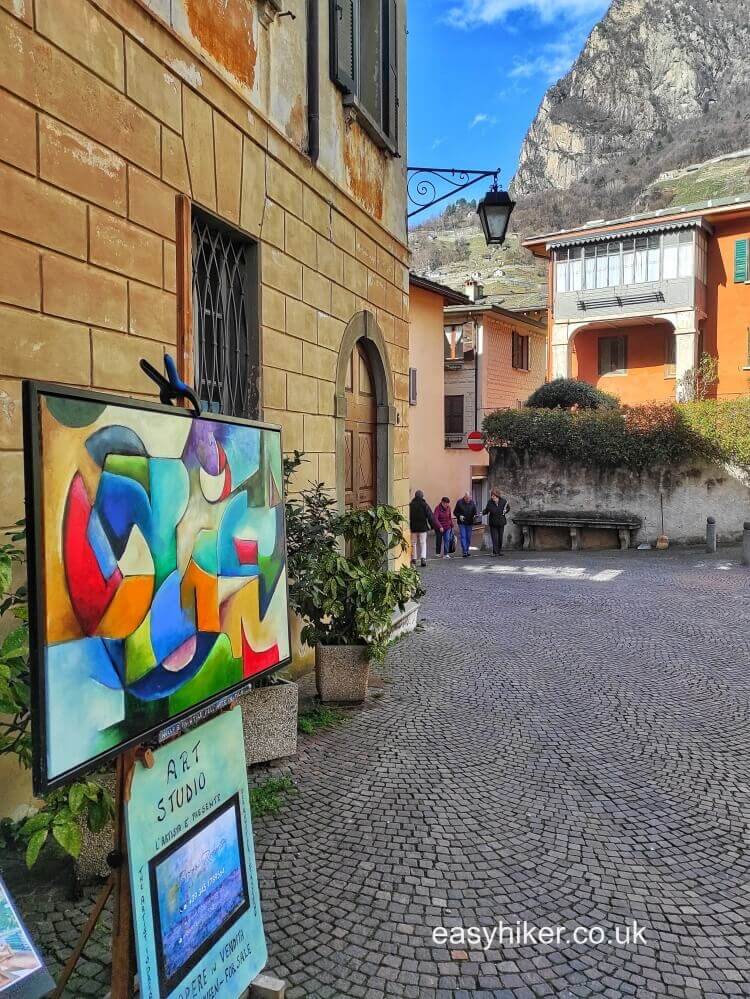
… while, particularly near the San Lorenzo convent, also offering opportunities for moments of quiet contemplation.
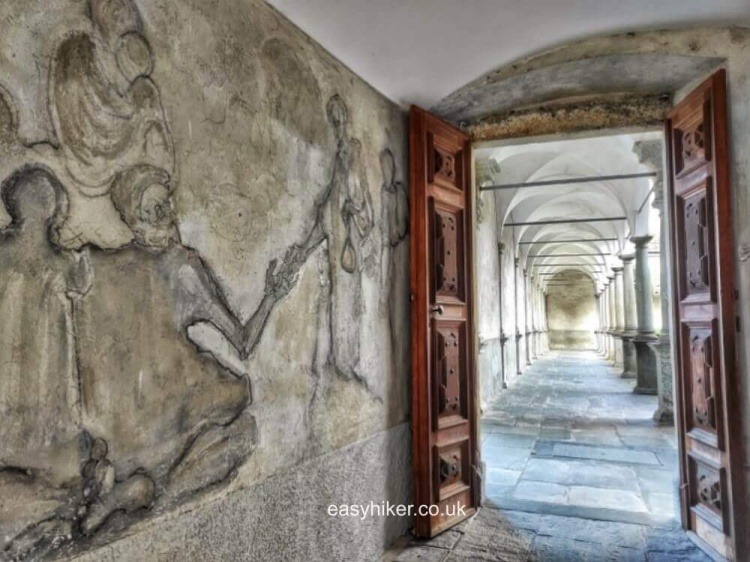
After you have strolled through the relatively small but lively centro storico, it will be time for your mid-day meal, perhaps for an al fresco lunch in the shadow of one of Chiavenna’s historic landmarks.
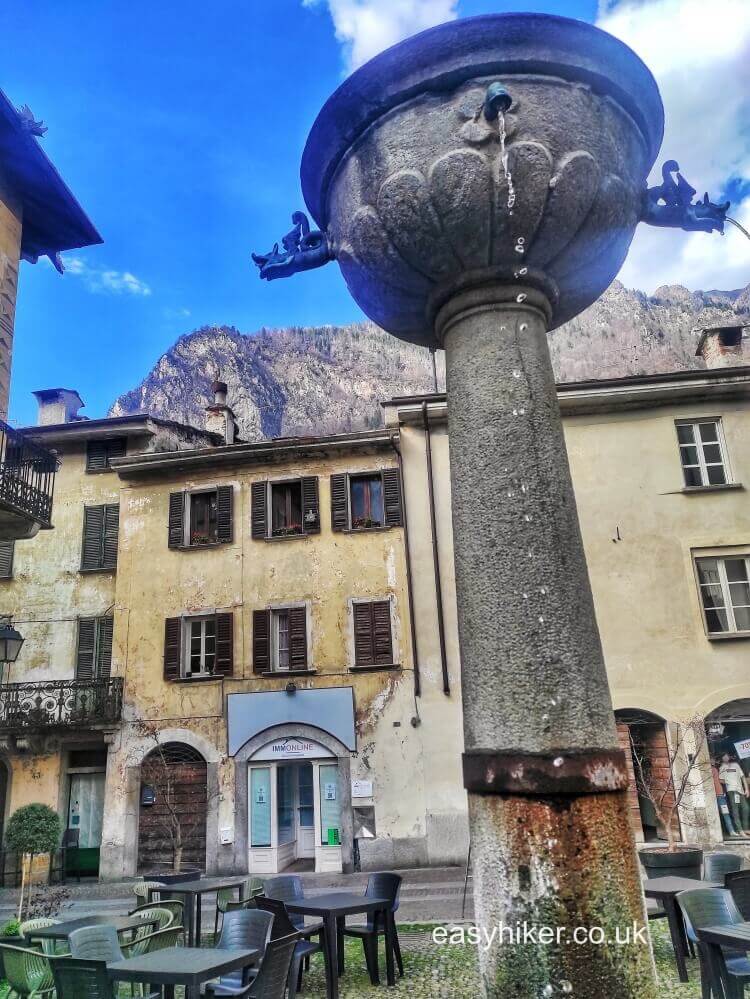
Finally, after your lunch, take a peek at the Crotti, the number three on our list and Chiavenna’s most unique feature.
Please note: a crotto is not a cave, although the closest English translation of the word is – you guessed right – indeed “grotto”.
But in this area of Italy, a crotto is understood to refer to a building with a cave, usually a cave that – whether it has formed naturally or has been hacked into an adjacent cliff face – lies not below but above the building itself and is more an annex or a shed than a cellar.
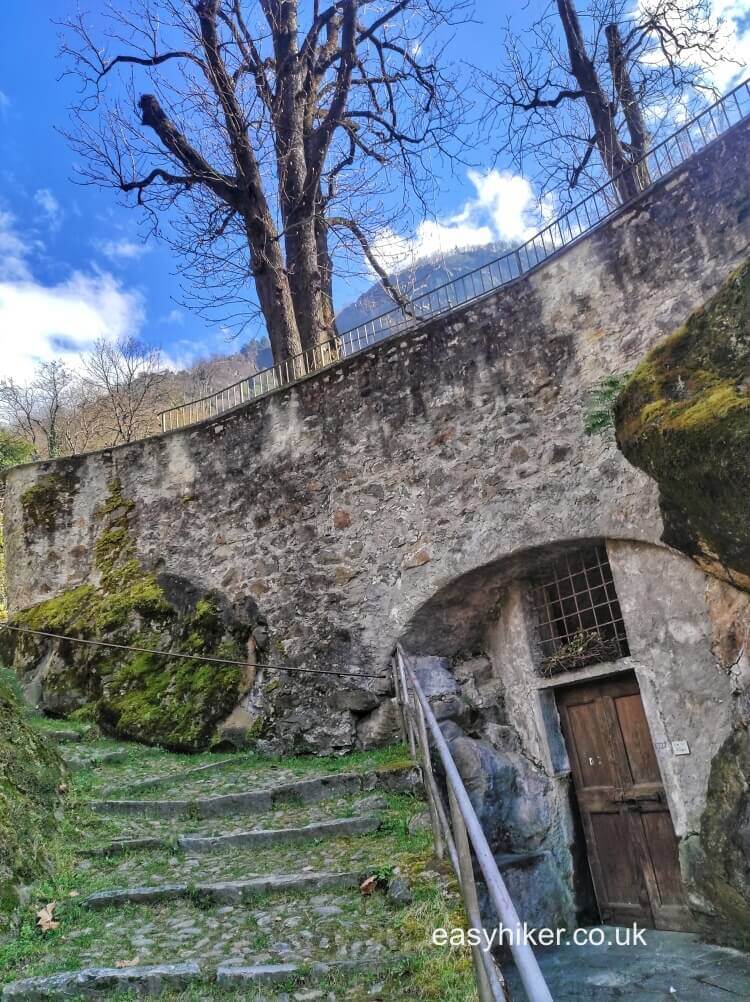
Chiavenna’s naturally air-conditioned crotti – most of which are concentrated along Corso Partogiano on the eastern side of the town centre – have been used for centuries as storage spaces for food or wine as well as, during the intensely hot summers of the region, as places to consume what has been stored in there (particularly the wine) in the animated company of family and friends.
To continue to experience the magic of Chiavenna, while you are in this part of town, you may also want to take a peek at the Palazzo Balbiani on Piazza Castello. What may look like the medieval version of George Orwell’s Ministry Of Love was in fact the residence of the local aristocratic warlord, the Duke of Varenna.
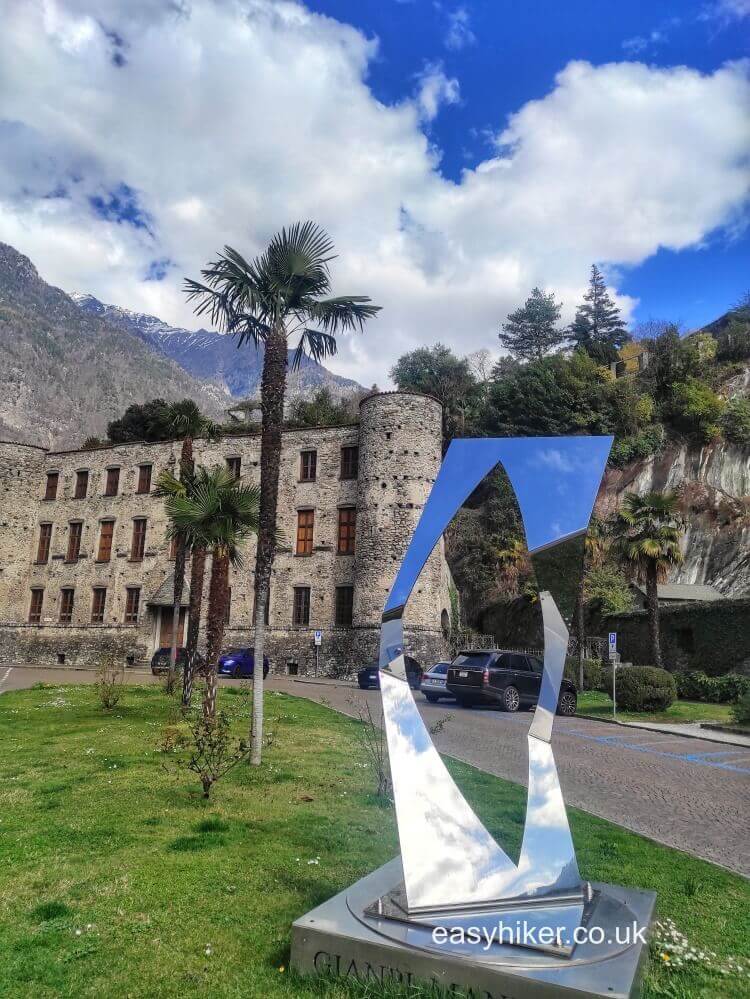
Chiavenna has many other historic sights like that, all highlighted by a scenic backdrop. And when the sun shines and the sky is blue, you will feel the magic of Chiavenna – while also recognising the family likeness it shares with all the other wonderful places that grace this marvellous country.
Viva Italia!