Here is something about WWII that you may not know: the most heavily destroyed European cities were not located inside Germany but on the country’s periphery: the Reich’s main line of defence. Brest, Warsaw and Stalingrad experienced brutal ground battles and house-to-house combat, and at the end of the war, roughly 95 percent of these cities lay in ruins.
In Germany itself, by contrast, most damage was done by US and British air raids, and when the allied ground troops arrived, the exhausted nation’s will to fight had already been broken.
These allied bombardments concentrated on industrial zones, major rail hubs – and, in Berlin, the government quarter. But although Berlin also experienced intense close-quarters combat in the last days of the war, not all of the Third Reich’s government buildings were destroyed.
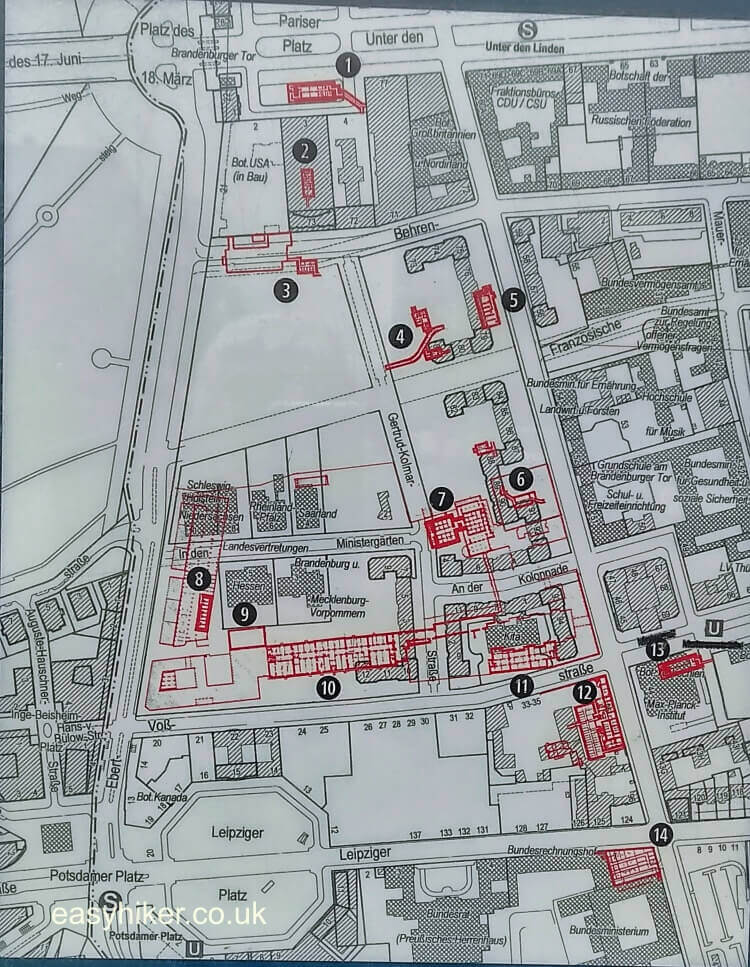
It is still possible to trace back Nazi Berlin even in the administrative heart of the Evil Empire: the quarter around Wilhelmstrasse, once centred on the Albert-Speer-designed Reichskanzlei from where Adolf Hitler – at the peak of Germany’s powers – ruled most of Europe.
Tracking Down the Nazis in Berlin
At the end of WWII, Berlin’s government quarter fell into Soviet hands, and the Red Army completely demolished the Reichskanzlei. But eventually, the Russians had to square the will to erase all traces of Nazi government with their own need for office buildings in a devastated city. Even some historically fraught architecture was carefully recycled. Which is why the buildings from which many top Nazis conducted their business are still there.
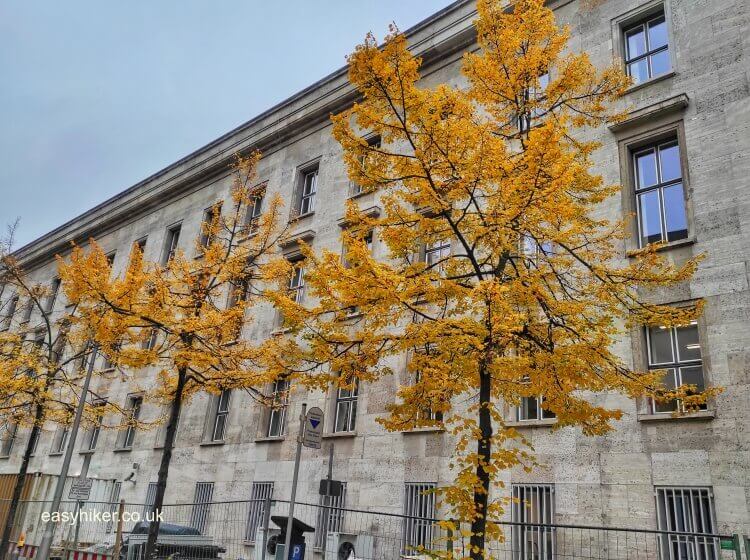
To track down the Nazis in Berlin, we start with Joseph Goebbels’ Ministry of Propaganda, or rather: with its one wing that still stands on Mauerstrasse. The building is disappointingly banal, certainly nothing like the Ministry Of Truth from central casting, featuring a metronomic rhythm that is repeated ad infinitum – or at least until as far as the eyes can see at the end of the block. (If you find the style appealing, this is your lucky day, because there is more of it to come.)
But first, a change of tone. The building on Wilhelmstrasse 64 – it used to house the offices of Rudolf Hess, nominally the Number 2 in the Nazi hierarchy as the Fuehrer’s deputy – was constructed in the late 19th century for Kaiser Bill’s Imperial government.
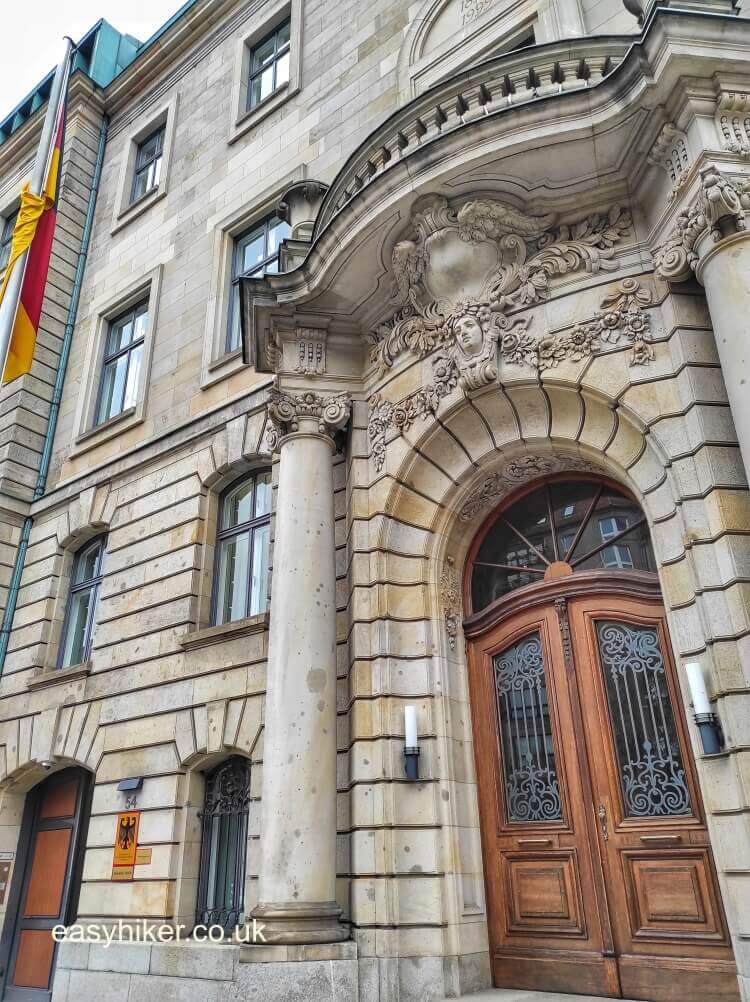
It was one of the few official Nazi buildings that had been repurposed from existing Prussian government stock – probably because the increasingly sidelined Rudolf Hess was not deemed important enough to merit a costly new-build.
Not many people come to visit the building today, in stark contrast to the next site on our itinerary. The fact that there is actually not much to see on the corner of Gertrud-Kolmar-Strasse and the Ministergaerten appears not to deter the hordes of tourists …
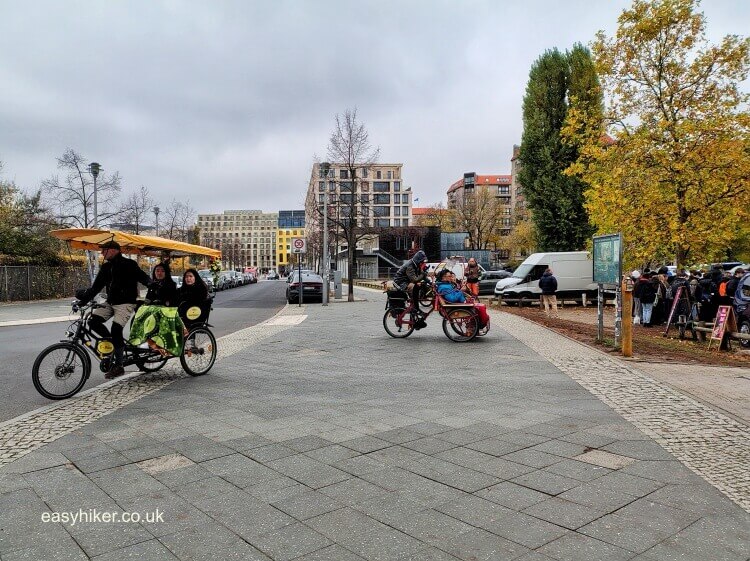
… who are coming here in search of the Heart of Darkness.
Downfall: ten metres underneath the parking lot and the modern housing development, in what were then the gardens of the Reichskanzlei, Adolf Hitler built a sprawling underground residence-cum-office-complex into which he retreated – more or less for good – in January 1945. This was also where Hitler – together with several members of his entourage – eventually committed suicide. The Chamber of Horrors of world history: you are standing right on top of it.
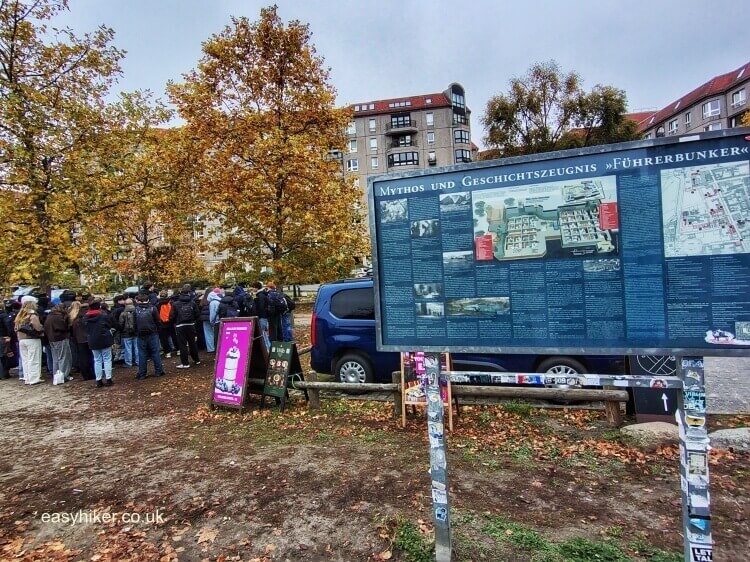
In fact, the Hitler bunker was only the centrepiece in a complex network of underground government bunkers. How much of this structure is still intact remains a well-kept secret. We know that the Russians unsuccessfully tried to dynamite the Fuehrerbunker, the exact location of which was subsequently forgotten.
According to the official version, East German building workers chanced upon the bunker’s remains during the construction of the housing settlement in the late 1980s and “took the structure down” or “resealed” it.
But we also know that post-war German governments of all colours have always wanted to prevent the site from becoming a Neo-Nazi pilgrimage shrine. In fact, the location of the bunker was only disclosed in 2006, when the info panel with a diagram of the bunker system was erected.
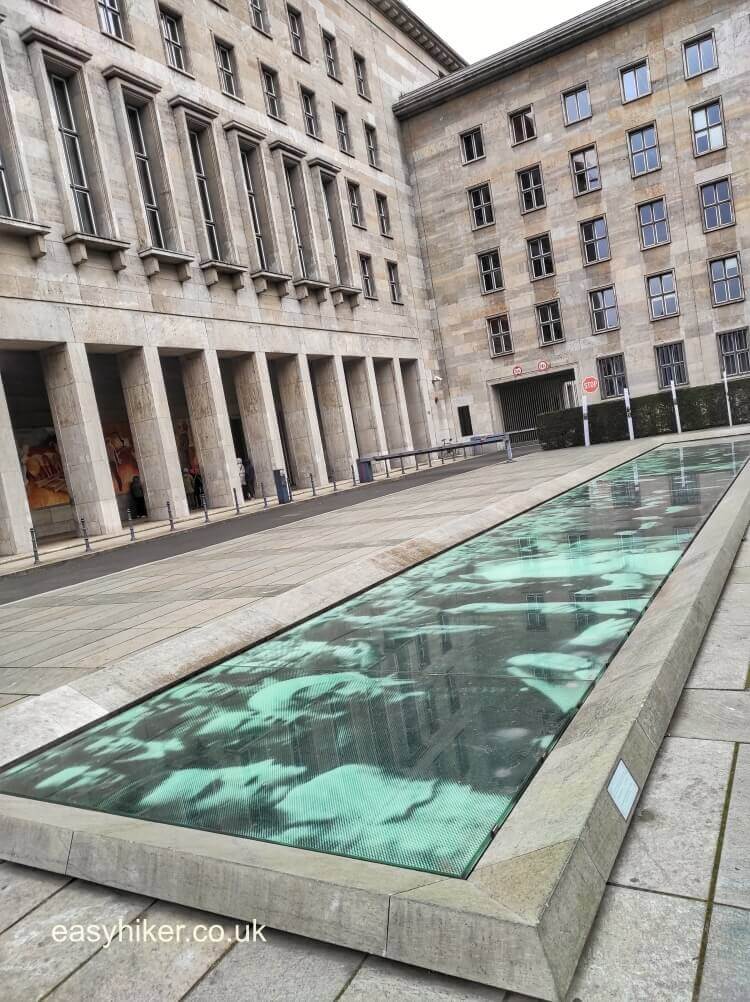
We now return to Wilhelmstrasse to take a look at the Nazi era’s most storied building: the office block at no. 97 was built in the mid 1930s for the Aviation Ministry , the realm of Hermann Goering …
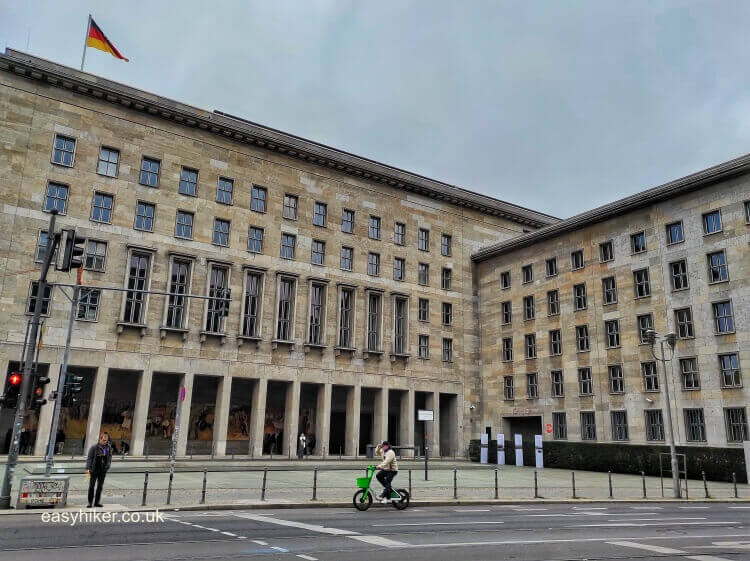
… and has survived virtually intact – only the Nazi army and party insignia were removed.
In the parts of Berlin that were controlled by the western allies, you may still find the occasional Third Reich stone eagle (on less compromised buildings such as the office blocks of the old Tempelhof airport) …
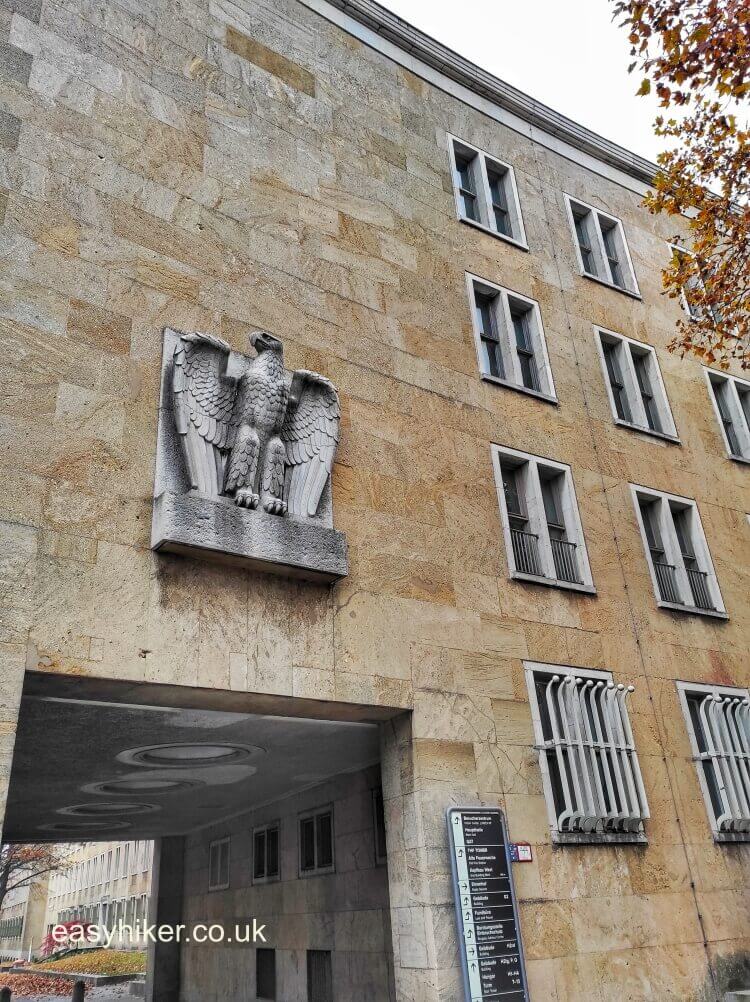
… but for East Berlin’s new Communist government, such half-heartedness was never an option. Not least because they had decided to use the office block – the largest in early 20th century Berlin – as their administrative hub where all ministerial departments would operate under one roof. Traces of the communist occupancy can still be found on the building’s facade.
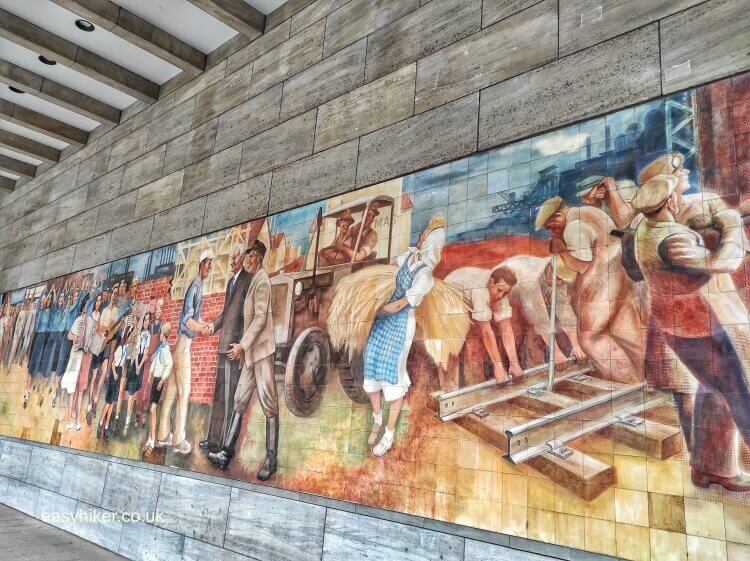
After the fall of the wall, the Treuhand moved in (the company that had been established to liquidate the East German Republic) before making way for Federal Germany’s Finance Ministry.
But beyond its contribution to the annals of German administration, the building has also played a key role in the wider German history: it was here, in front of the communist government’s Control Room, where workers gathered on 17 June 1953 to protest against low wages and belt-tightening measures.
These protests quickly escalated into a general uprising that was violently suppressed by the government – events that are today commemorated by a glass panel in front of the building.
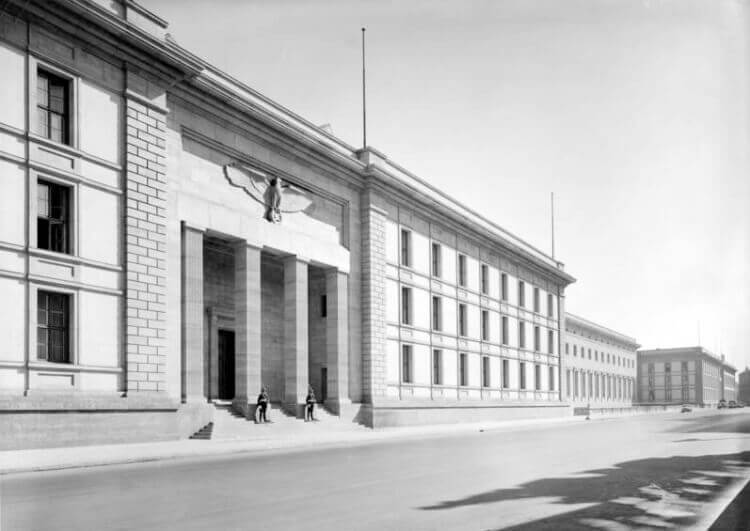
Passing by the ruins of the old Gestapo HQ on Niederkirchnerstrasse, we continue to the building on Friedrichstraße 34, which was constructed as the regional office for the National Employment Agency – which is pretty much what it is is today.
The building is of minor political importance but possibly the most accomplished specimen of the period’s architecture. (This is an archive photo since the building is undergoing an extensive renovation.)
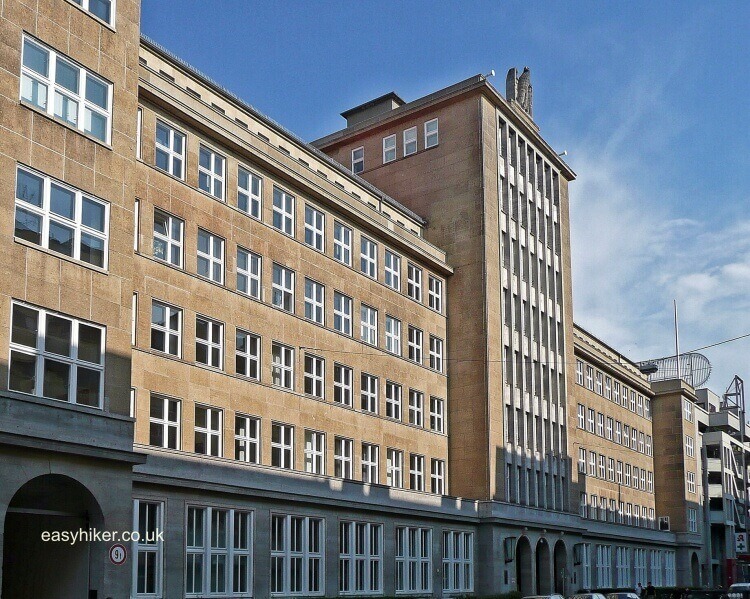
Friedrichstrasse is also a good place to learn how much you can find out about the history of any Berlin street just by paying attention. Did you notice that the Regional Employment Office at no. 34 looks at buildings in the 200s on the other side of the street?
Originally, all streets in Berlin were numbered following the horseshoe system: 1, 2, 3 and so on until the end of the street and then looping back in the opposite direction. After WWII, this system was only kept for those streets whose layout had been preserved. For the streets that were radically rerouted, even if they had kept their old name, the more common zig-zag system was introduced.
You can study this system on the 2-km walk to the next station on our itinerary. But you can also take a bus (M29 to Roseneck; the nearest bus stop is Kochstraße, 100 metres south of Checkpoint Charlie). Descend at the Gedenkstätte Deutscher Widerstand from where it is a short walk up Stauffenbergstrasse to the old seat of the Nazi army’s High Command.
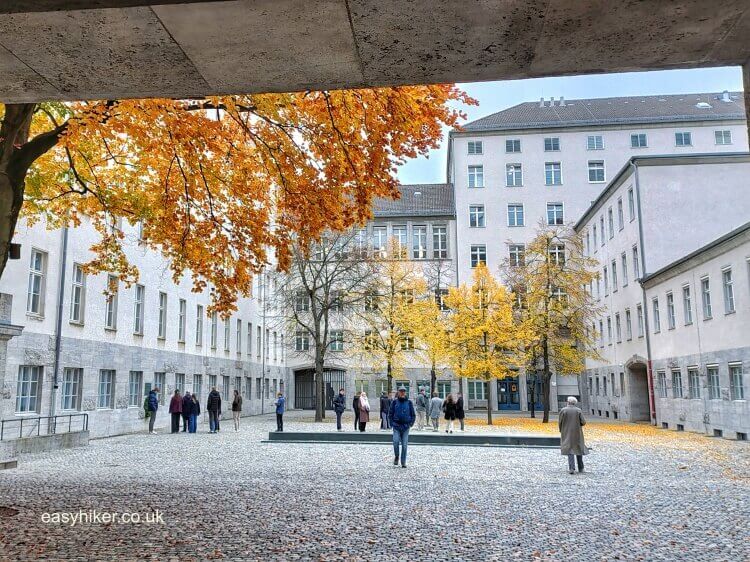
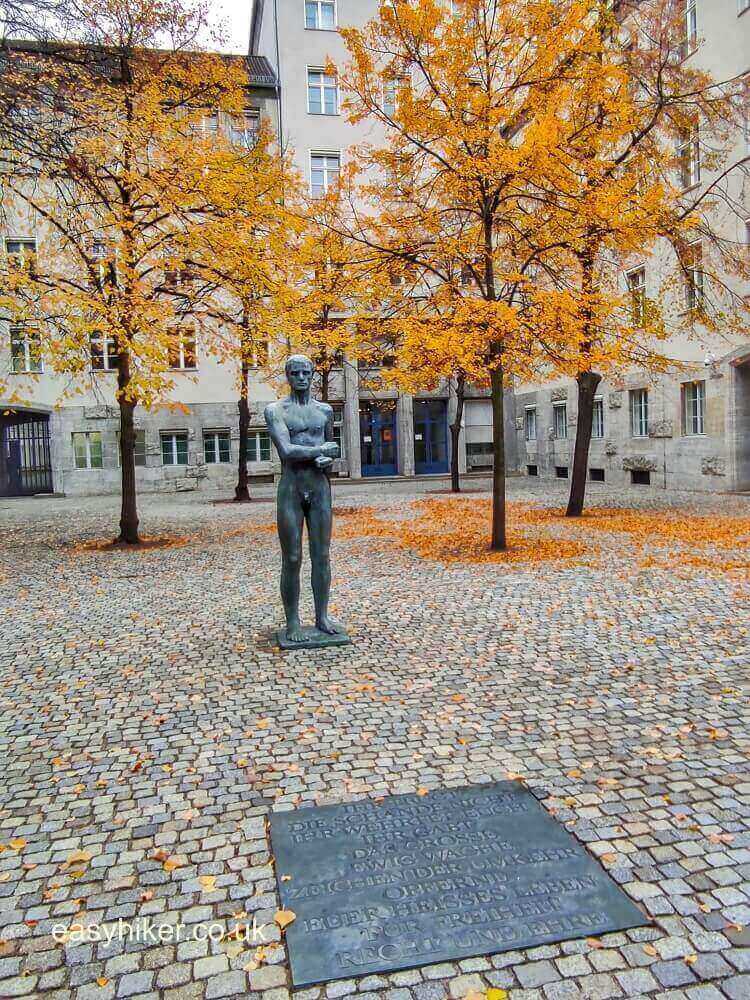
In one courtyard within the building complex – which is today a Memorial for the German Resistance – the leaders of the unsuccessful military coup against Hitler were executed in July 1944. The statue marks the place where the shootings took place.
After all this blood and mayhem, not to mention the surfeit of heavy-handed architecture, you may now be in need of some light relief, and we suggest a short walk to Hiroshimastraße where Nazi Germany built the Embassies for its two top international allies, Japan and Italy …
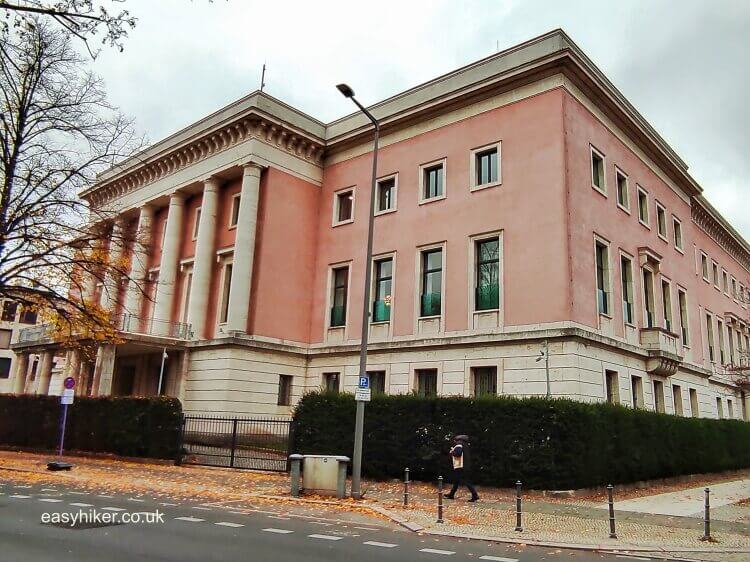
… in an apparent attempt to serve up a lightened version of its usual architectural fare.
The Italian Embassy makes some polite nods in the direction of Mediterranean traditions – colour, ornamental columns, balcony – but overall comes across as the visual equivalent of a German oompah band playing Neapolitan folk songs.
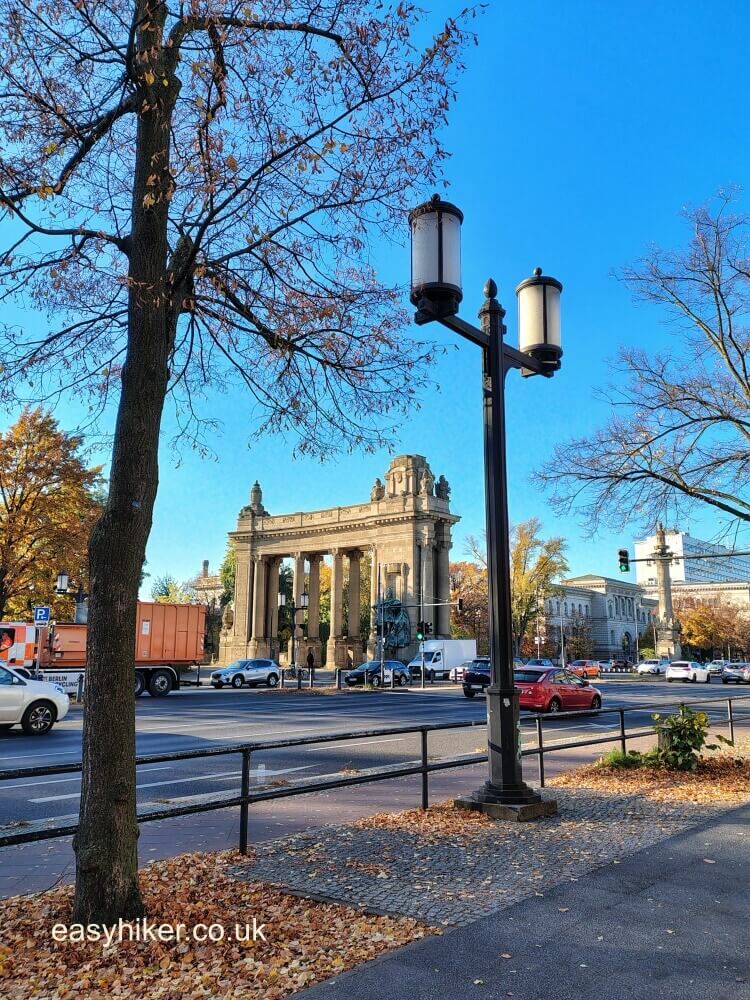
To wrap up, we suggest a trip to the near-by Strasse des 17. Juni, planned as the main boulevard of Hitler’s World Capital Germania.
The 300-meter-high Hall Of Glory and the Triumphal Arch never left Albert Speer’s drawing board, even the street itself was only partly finished.
But there is one element of the Grand Plan that was fully realized: the triumphal boulevard’s streetlights – and they are still there. Who ever said that the Third Reich did not produce good jokes?